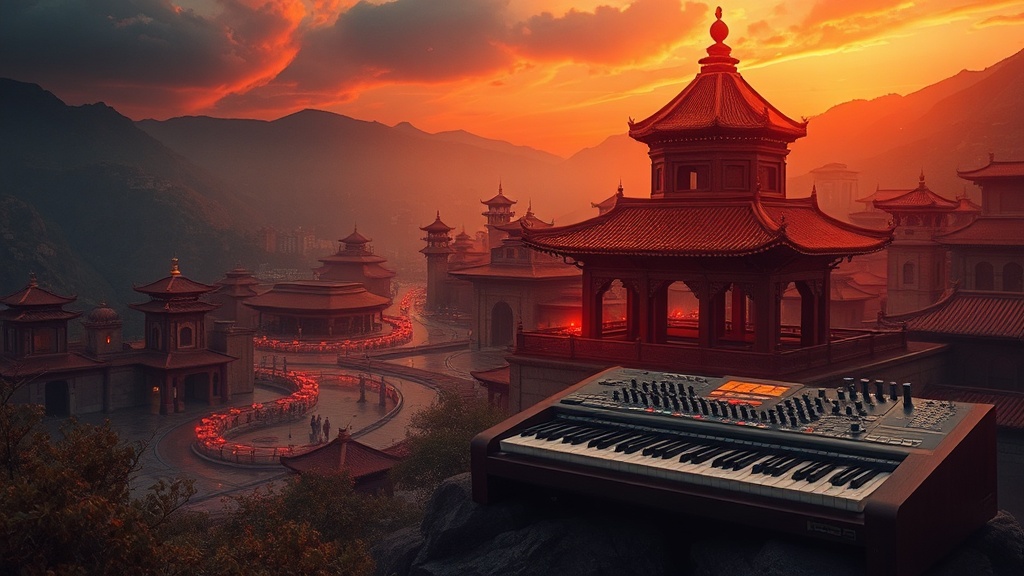
Lost Echoes of the Silk Road in Modern Synthesizer Melodies

A merchant in 13th-century Samarkand unrolls a bolt of silk, while a few miles away, a musician tunes a stringed instrument that sounds nothing like the heavy, rhythmic drums of the western steppe. This intersection of sound and trade isn't just a relic of the past; it's the DNA of the modern synthesizer. We're looking at how the ancient melodic structures of the Silk Road—the scales, the microtonal shifts, and the unique timbres—have been rediscovered and digitized by modern electronic musicians. It’s a strange, beautiful loop where ancient trade routes meet cutting-edge voltage-controlled oscillators.
The connection between historical musical theory and modern synthesis isn't accidental. It’s a deliberate attempt by producers to capture a sense of "otherness" that Western classical music often ignores. When you hear a shimmering, oscillating pad on a high-end synthesizer, you're often hearing a digital approximation of an ancient aesthetic.
How did the Silk Road influence musical scales?
The Silk Road influenced musical scales by acting as a massive, slow-motion conveyor belt for mathematical ratios and tonal systems across Eurasia. As traders moved goods, they moved the mathematical foundations of music. The Persian maqam, the Indian raga, and the Chinese pentatonic scales didn't stay localized; they bled into one another through the movement of people and instruments. This created a massive, cross-continental library of intervals that don't always fit into the standard 12-tone Western scale.
Modern synthesizers are built on the Western 12-tone equal temperament system, which is a bit of a problem for anyone trying to replicate these ancient sounds. If you want to play a traditional Middle Eastern melody on a standard keyboard, you'll find yourself stuck. You'll hit a "wrong" note because the scale requires a microtonal shift—a note that sits *between* the keys. This is where the real magic happens in the digital age.
Today, producers use software like Spectrasonics Omnisphere to bridge this gap. It’s not just about playing a preset; it's about using oscillators to recreate the "instability" of an ancient instrument. A real wooden flute or a silk-stringed lute doesn't stay perfectly on pitch—it breathes. Synthesizers attempt to mimic that breath through LFOs (Low-Frequency Oscillators) and subtle pitch drifts.
Think about the way a Moog synthesizer sounds. It has this organic, slightly unpredictable quality. That "imperfection" is what makes it feel human. It's the same reason a traditional oud sounds so soulful—it's the slight deviations from a perfect, sterile pitch that give the music its emotional weight.
The Evolution of Sound: From Silk to Silicon
The transition from physical vibration to digital code is a fascinating leap. In the past, a musician had to physically manipulate a string or a piece of silk to change a tone. Now, we manipulate voltage and algorithms. But the goal remains the same: the pursuit of a specific, evocative frequency.
To understand how these sounds have changed, look at this comparison of traditional instrument mechanics versus modern synthesis approaches:
| Feature | Traditional Silk Road Instrument (e.g., Oud) | Modern Synthesizer (e.g., Prophet-5) |
|---|---|---|
| Primary Source | Physical vibration of strings/air | Oscillating electrical voltage |
| Tonal Control | Manual pitch bending/finger placement | LFOs, Envelopes, and MIDI automation |
| Microtonality | Natural, organic pitch drift | Manual tuning or MPE (MIDI Polyphonic Expression) |
| Texture | Acoustic resonance and wood grain | Waveforms (Sawtooth, Square, Sine) |
The jump from a physical string to a digital waveform might seem massive, but the logic is identical. A string vibrates at a frequency; a synthesizer oscillator vibrates at a frequency. The difference is simply the medium of the vibration.
Why do modern electronic producers use microtonal scales?
Modern electronic producers use microtonal scales to escape the predictable, repetitive loops of standard Western pop and to evoke a deeper, more "ancient" emotional response. There's a certain fatigue that sets in when you hear the same four chords for the hundredth time. Microtonality—the use of notes that fall between the standard keys—breaks that pattern. It creates a sense of tension and release that feels much more organic and "unsolved."
When a producer uses a synthesizer to mimic the Maqam system, they aren't just being fancy. They're tapping into a psychological trigger. Certain intervals sound "unsettled" to a Western ear because we've been conditioned to expect the resolution of a major or minor chord. When that resolution doesn't come, or when it comes in a way that's slightly "off," it creates a sense of wonder or even unease.
This isn't just a niche hobby for experimentalists. You'll hear these subtle, microtonal textures in much of the high-end electronic music today. It’s a way to add "soul" to a machine. If a sound is too perfect, it feels dead. By introducing the "errors" found in Silk Road music—the slight bends, the non-standard intervals—the producer makes the digital machine feel alive.
It's a bit like the difference between a digital photograph and a film photograph. The digital one is technically "better" in terms of resolution, but the film one has that grain, that slight imperfection that makes it feel real. Music is the same way. The "grain" of the Silk Road is the microtonal bend.
That said, not everyone can pull this off. It requires a deep understanding of how to manipulate pitch without making it sound like a broken instrument. You have to be intentional. If you just use random pitches, it's noise. If you use calculated microtonality, it's a masterpiece.
The Digital Rebirth of Ancient Timbre
The way we think about "texture" in music has changed. In the 1970s, synthesizers were often used to create "space-age" sounds—sounds that felt like the future. Today, we use them to reach back into the past. We use the technology to reconstruct the textures of the Silk Road—the rasp of a bowed instrument, the breathy quality of a reed, the shimmering decay of a metal plate.
This is a complete reversal of the 20th-century trend. We've gone from trying to sound more "mechanical" to trying to use machines to sound more "ancient." It's a strange, circular movement in culture. We use the most advanced silicon chips on the planet to try and capture the ghost of a wooden flute from 800 years ago.
A great example of this is the work seen in modern ambient and "organic electronic" genres. Artists aren't just layering beats; they're layering histories. They're using granular synthesis—a method where a sound is broken into tiny "grains"—to create textures that feel both digital and incredibly ancient. It’s a way of blurring the line between the organic and the synthetic.
- The Grain: Breaking a sound down into its smallest components to manipulate its texture.
- The Pitch: Using microtonal scales to escape the 12-tone Western trap.
- The Atmosphere: Using reverb and delay to simulate the vast, open spaces of the Silk Road deserts.
This brings us to a realization: the synthesizer isn't just a tool for the future. It's a time machine. It allows us to take the mathematical DNA of ancient civilizations and re-express it through the lens of modern technology. It's not about replacing the old sounds, but about finding their digital echoes and amplifying them for a new generation.
When you listen to a track that feels "epic" or "otherworldly," don't just look at the beat. Look at the way the notes bend. Look at how the synthesizer breathes. You might just be hearing the ghost of a merchant's song, traveling through a circuit board.