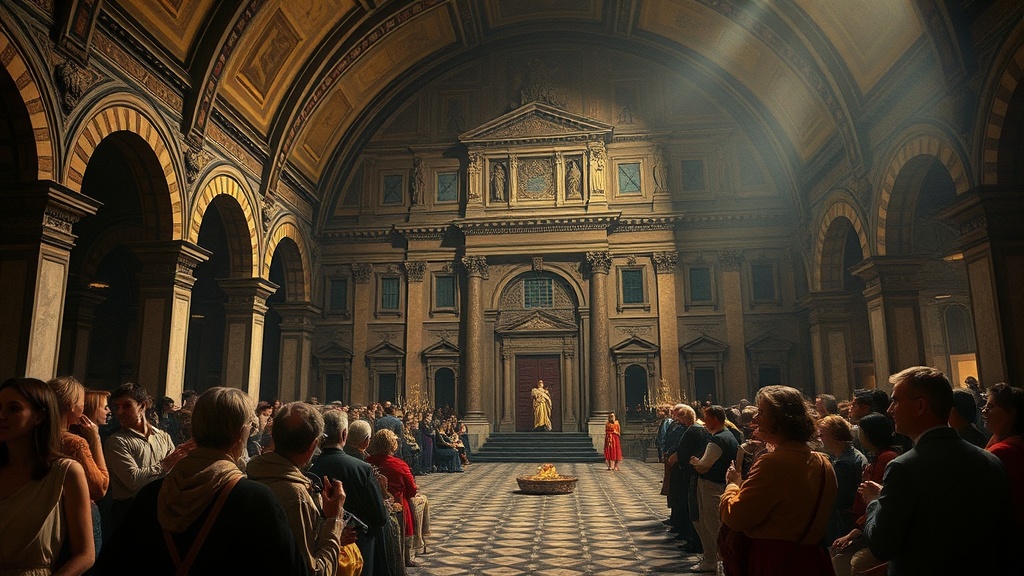
Exploring the Hidden Language of Renaissance Propaganda

In the late 15th century, a single woodcut print could change the fate of a dynasty more effectively than a thousand soldiers. This post examines the visual codes, symbolic trickery, and artistic-political strategies used during the Renaissance to manipulate public perception. We'll look at how art wasn't just for beauty—it was a weapon of statecraft used to cement authority and broadcast power across a largely illiterate population.
The Renaissance wasn't just a rebirth of art; it was a rebirth of control. While we often view the era through the lens of "high art," much of the period's most famous output was actually a sophisticated form of psychological warfare. Portraits weren't just likenesses. They were carefully constructed brands designed to signal legitimacy, divine right, and unshakeable strength.
How Did Renaissance Rulers Use Art for Power?
Renaissance rulers used art to project an image of divine legitimacy and absolute authority to both their subjects and their rivals. They didn't just commission paintings; they engineered visual identities. If a king wanted to be seen as a wise philosopher, he didn't just say it—he sat for a portrait surrounded by specific symbols of intellect and ancient virtue.
Take, for example, the way the Medici family in Florence used patronage to mask their status as mere bankers. By funding massive architectural projects and religious art, they bought social and political capital. They weren't just wealthy; they were the indispensable architects of a new era. This kind of "soft power" is something we still see in modern geopolitics, though the medium has shifted from oil on canvas to digital media.
The use of iconography was precise. A certain type of laurel wreath or a specific shade of crimson wasn't an accident. These were the visual cues of the time. If you saw a ruler depicted with a Roman laurel, you understood immediately: this person is the successor to the greatness of antiquity. It's a way of bypassing the need for a written manifesto.
The visual language of the era often relied on:
- Classical Allusions: Linking the ruler to Greek or Roman gods to imply a "natural" right to rule.
- Spatial Hierarchy: Placing the subject in the center or slightly above the viewer to enforce a sense of distance and awe.
- Color Theory: Using expensive pigments like ultramarine (made from lapis lazuli) to signal immense wealth and divine favor.
It's a bit like how a modern tech giant uses minimalist design to signal "innovation" and "simplicity." The message is embedded in the aesthetic itself.
What Are the Symbols of Authority in Renaissance Art?
Symbols of authority in the Renaissance were specific objects or attributes that communicated a person's status, lineage, or divine connection to a viewer. These weren't just decorations—they were the "logos" of the 1500s.
Consider the way a crown or a scepter is positioned. It’s rarely just sitting there. It's often held with a specific type of grip or placed in a way that suggests the weight of responsibility—or the absolute right to command. Even the way a hand is positioned in a portrait could signal whether a leader was a "warrior king" or a "peaceful administrator."
Here is a breakdown of common symbolic visual cues used during this period:
| Symbol | Primary Meaning | Political Intent |
|---|---|---|
| The Lion | Strength and Courage | To intimidate rivals and signal military prowess. |
| The Mirror | Truth and Self-Knowledge | To suggest the ruler is wise and possesses clarity. |
| The Dog | Fidelity and Loyalty | To emphasize the loyalty of the subjects to the crown. |
| The Globe | Universal Dominion | To claim influence over distant lands and trade routes. |
One of the most fascinating aspects of this era is how these symbols were often "encoded." A viewer with a classical education would see a subtle reference to a specific myth, while a commoner might only see the majesty of the colors. It was a dual-layered communication system. It kept the elite in the loop while still commanding the respect of the masses. It's much like the complexities of Renaissance art that still baffle historians today.
The trick was making the propaganda look like "natural" beauty. If a painting is beautiful, you don't question the motive behind it. You just admire the skill. That's the ultimate success of a propaganda campaign: when the audience forgets they are being sold an idea.
Why Does Renaissance Propaganda Matter Today?
The techniques developed during the Renaissance—the use of color, symbolism, and curated imagery—form the foundational blueprint for modern political and commercial branding. We haven't actually changed that much; we've just changed the tools.
When a politician stands in front of a flag, or a brand uses a specific shade of blue to imply trust, they are using a modernized version of the same visual shorthand. The Renaissance taught us that an image can bypass the rational brain and go straight to the emotional one. It's a direct line to how people feel about power and identity.
We can see the echoes of this in how historical narratives are constructed. For instance, the way certain historical figures are portrayed in museums or even in cinema is often a curated version of the truth. It's a "polished" history. This connects deeply to how we understand the mechanics of global power and how certain nations project their "brand" on the world stage today.
The art of the Renaissance wasn't just about painting a pretty picture. It was about the construction of a reality. A reality where the ruler was a god, the state was eternal, and the hierarchy was unshakeable. It's a lesson in the power of the visual that remains incredibly relevant in an age of deepfakes and algorithmic influence.
A great example of this is the way certain modern luxury brands, like Louis Vuitton or Rolex, use their visual identity. They aren't just selling leather or steel; they are selling a sense of "nobility" and "permanence" that feels almost ancient. They are using the same psychological triggers that a 16th-century Duke would have recognized instantly.
It's also worth noting that this wasn't just a European phenomenon. While we focus on the Italian Renaissance, similar visual strategies were being used in the Ming Dynasty in China and the Ottoman Empire. The desire to project a "perfected" image of power is a universal human constant. It transcends geography and era.
If you look closely at the history of political scandals, you'll often find that the "fall" began when the visual illusion finally broke. When the person behind the symbol failed to live up to the symbol itself, the entire structure collapsed. This was often the case in the scandals that shaped history—the moment the mask slipped, the power vanished.
Understanding these visual codes helps us look at the world with a more critical eye. It helps us see that what we are seeing is rarely the whole truth. It is usually a carefully curated version of it. Whether it's a Renaissance portrait or a high-budget political advertisement, the goal is the same: to make you believe in a specific version of reality.